Canada · Fissure vent
Endeavour Segment
- Type
- Fissure vent
- Elevation
- 2050m (submarine)
- Last eruption
- -3490
- Type
- Fissure vent
- Country
- Canada
- Region
- Eastern Pacific / Northeast Pacific Rifts Volcanic Province
- Elevation
- 2050m (submarine)
- Coordinates
- 47.950, -129.100
- Last eruption
- -3490
- Tectonic setting
- Rift zone / Oceanic crust (< 15 km)
- Landform
- Cluster
- Major rock type
- Basalt / Picro-basalt
Geological summary
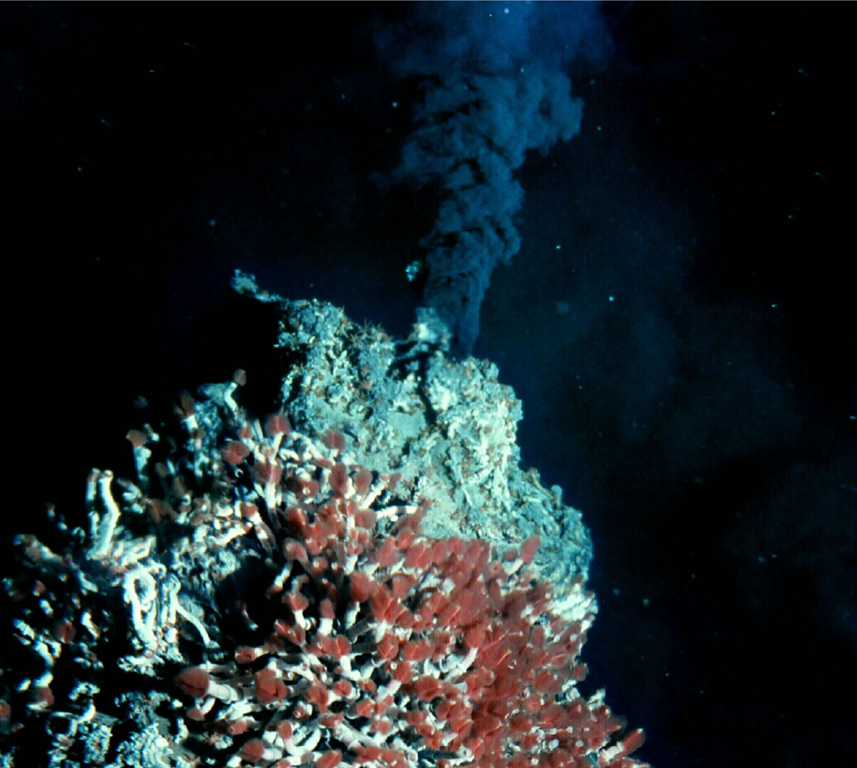
The Endeavour Segment (or Ridge) lies near the northern end of the Juan de Fuca Ridge, W of the coast of Washington and SW of Vancouver Island. The northern end is offset to the east with respect to the West Valley Segment, which extends north to the triple junction with the Sovanco Fracture Zone and the Nootka Fault. The 90-km-long, NNE-SSW-trending segment lies at a depth of more than 2,000 m and is the site of vigorous high-temperature hydrothermal vent systems that were discovered in 1981. Five major vent fields that include sulfide chimneys and black smoker vents are spaced at about 2-km intervals in a 1-km-wide axial valley at the center of the ridge. Preliminary uranium-series dates of Holocene age were obtained on basaltic lava flows, and other younger "zero-age" flows were sampled. Seismic swarms were detected in 1991 and 2005.
Eruption history
2 recordedGlossaryDetailed timeline
- 3490 BCEVEI 0Geological estimate3490 BCE – end unknown
- 6930 BCEVEI 0Geological estimate6930 BCE – end unknown
Nearby volcanoes
External links
- Not yet on Wikipedia (English). You can contribute on Wikidata.
- Smithsonian GVP source page
⚠ For reference only. Not for emergency response.