Japan · Caldera

Hijiori

Type
Caldera
Elevation
552m
Last eruption
Unknown
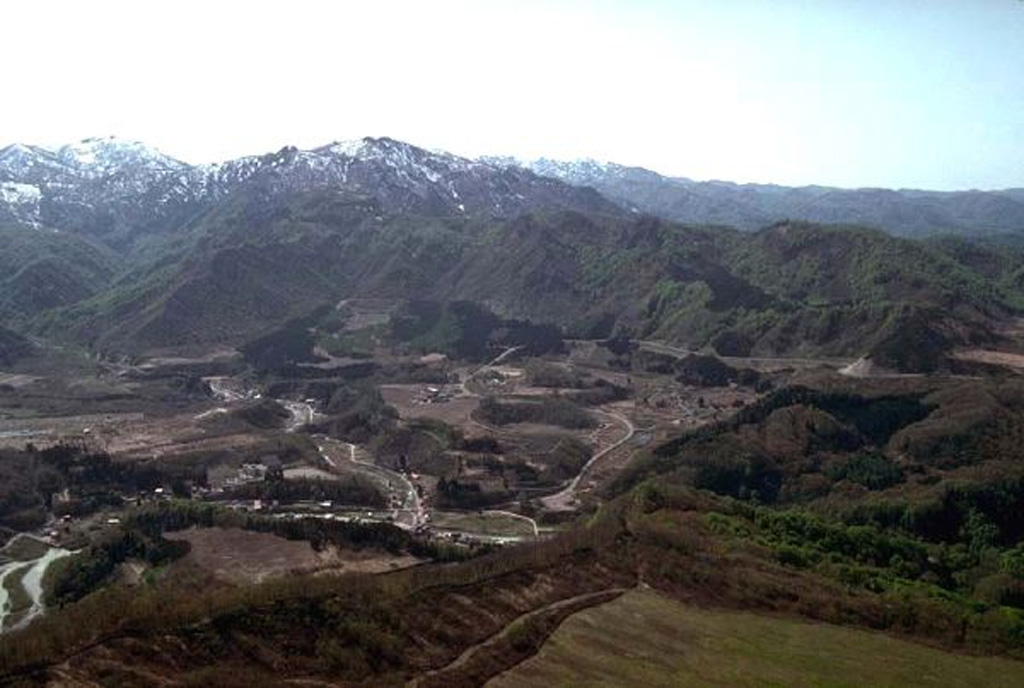
Hijiori volcano, seen from the E, is a small caldera located NE of the Pleistocene Gassan volcano. The town of Hijiori lies in the left foreground along the banks of two rivers through the caldera floor. The low 2.5-km-wide caldera formed during a large eruption between about 9,500 and 11,000 years ago, accompanied by pyroclastic flows and ashfall that extended to the E and reached the Pacific coast.
Hijiori volcano, seen from the E, is a small caldera located NE of the Pleistocene Gassan volcano. The town of Hijiori lies in the left foreground along the banks of two rivers through the caldera floor. The low 2.5-km-wide caldera formed during a large eruption between about 9,500 and 11,000 years ago, accompanied by pyroclastic flows and ashfall that extended to the E and reached the Pacific coast. · Photo: Copyrighted photo by Hiroshi Yagi (Japanese Quaternary Volcanoes database, RIODB, http://riodb02.ibase.aist.go.jp/strata/VOL_JP/EN/index.htm and Geol Surv Japan, AIST, http://www.gsj.jp/).
Type
Caldera
Country
Japan
Region
Northwestern Pacific / Northeast Japan Volcanic Arc
Elevation
552m
Coordinates
38.599, 140.162
Last eruption
Unknown
Tectonic setting
Subduction zone / Continental crust (> 25 km)
Landform
Caldera
Major rock type
Dacite

Geological summary

Hijiori caldera is a small, inconspicuous caldera located NE of the Pleistocene Gassan stratovolcano.

Excerpt from the Global Volcanism Program, Smithsonian Institution · Read the full summary on GVP →

Eruption history

Glossary

Detailed timeline

No eruption records available.

Nearby volcanoes

External links

⚠ For reference only. Not for emergency response.